Why Do Darker Evening Dog Walks Change What You Should Wear?
Quick Answer: Daylight shortens by a couple of minutes a day through autumn, so an evening walk that was in full light in August is in near-darkness by mid-October without any change to your routine. Dark clothing is effectively invisible to drivers at distance, cooling temperatures change what you need for standing still while a dog sniffs, and wet pavements change grip. Reflective material and a light on the dog address the largest risk for the least effort.
Same lead, same route, same 6pm.
Completely different walk.
This is general information, not medical advice.
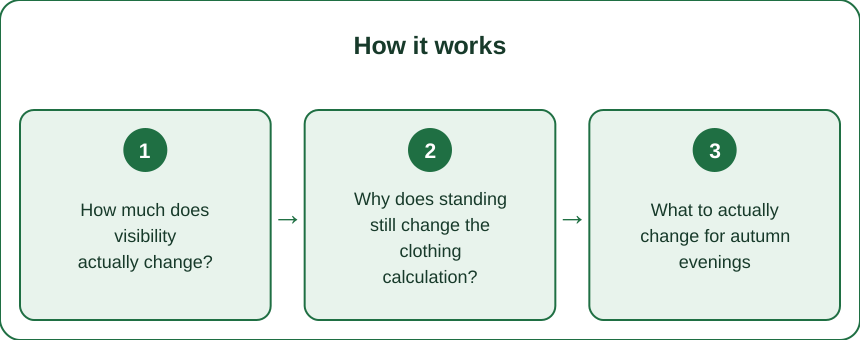
How much does visibility actually change?
More than intuition suggests, in both directions.
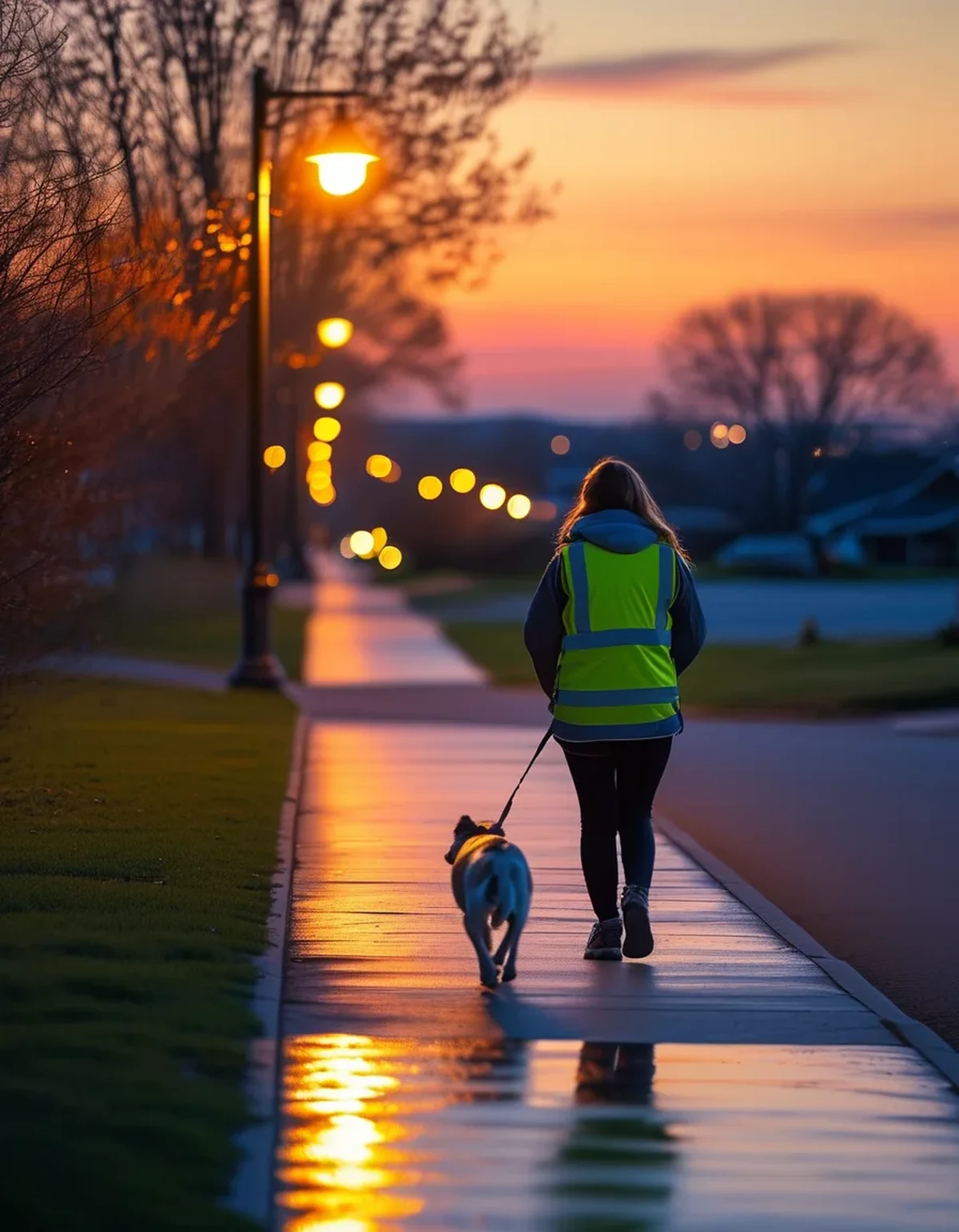
The first thing to understand is that you can see the car long before the driver can see you. Headlights are visible from a considerable distance and are bright against a dark background. A person in dark clothing on an unlit pavement is a low-contrast object with nothing to make them stand out, and drivers routinely report not seeing pedestrians until very close.
This asymmetry produces a specific and common error: because you can see the traffic clearly, you feel visible. You are not.
The numbers that matter in practice:
Dark clothing is visible at a fraction of the distance that reflective material is. Retroreflective material returns light directly back toward its source, which is why it appears to light up in headlights. It works at distances where plain light-coloured clothing does very little.
Fluorescent and reflective do different jobs. Fluorescent colours work in daylight and twilight, when there is some ambient light for them to work with. Retroreflective works in the dark with headlights. Dusk needs both, which is why the best autumn gear combines them.
Movement helps. Reflective material on ankles and wrists moves as you walk, and moving light is recognized more readily than static light. Reflective detail on shoes or ankle bands is disproportionately effective for its size.
What about the dog?
The dog is lower, often darker, and frequently on the road side of you. A light-up collar or a clip-on LED is inexpensive and it addresses the part of the pair that drivers see last.
Why does standing still change the clothing calculation?
Because a dog walk is not a walk. It is a series of walks with stops.
The pattern is familiar to every owner: three minutes of brisk movement, ninety seconds standing while the dog investigates something, repeat. Your body produces heat during the moving portion and loses it during the standing portion, and in October the standing portion is where you get cold.
This creates a requirement most walking advice does not address. You need clothing that works for intermittent activity rather than for continuous activity:
Wind protection matters more than insulation. Standing still in a light breeze loses heat quickly. A thin windproof layer outperforms a thicker non-windproof one for stop-start activity.
Extremities go first. Hands are usually the first complaint, partly because at least one is holding a lead and exposed. Gloves that work with a phone are the practical version, since most owners use their phone during the walk anyway.
A hood or hat is the fastest adjustment available. Head covering can be added and removed without stopping, which suits an activity where your temperature fluctuates every few minutes.
Pockets are genuinely functional here. Somewhere for hands, keys, bags, treats, and a phone. This is one of the few activities where pocket count materially changes the experience.
Does the dog need more too?
Depends heavily on breed, coat, age, and size. Short-coated, small, elderly, and young dogs feel cold much sooner than a thick-coated adult. A dog that stops, shivers, or slows on a cold walk is telling you something worth acting on.
What to actually change for autumn evenings
1. Add retroreflective material to what you already own. You do not need a new wardrobe. A reflective vest over any jacket, reflective ankle bands, or a clip-on reflector achieves most of the benefit for very little money. The vest is the single highest-value item.
2. Light the dog. A light-up collar, a collar clip, or a lead with reflective stitching. Dark dogs on unlit roads are close to invisible, and this is the cheapest safety improvement available.
3. Carry a torch or use a head torch. Being seen is one problem; seeing is another. Autumn pavements have leaves, mud, and things a dog will attempt to eat. A head torch keeps both hands free, which matters when one is holding a lead.
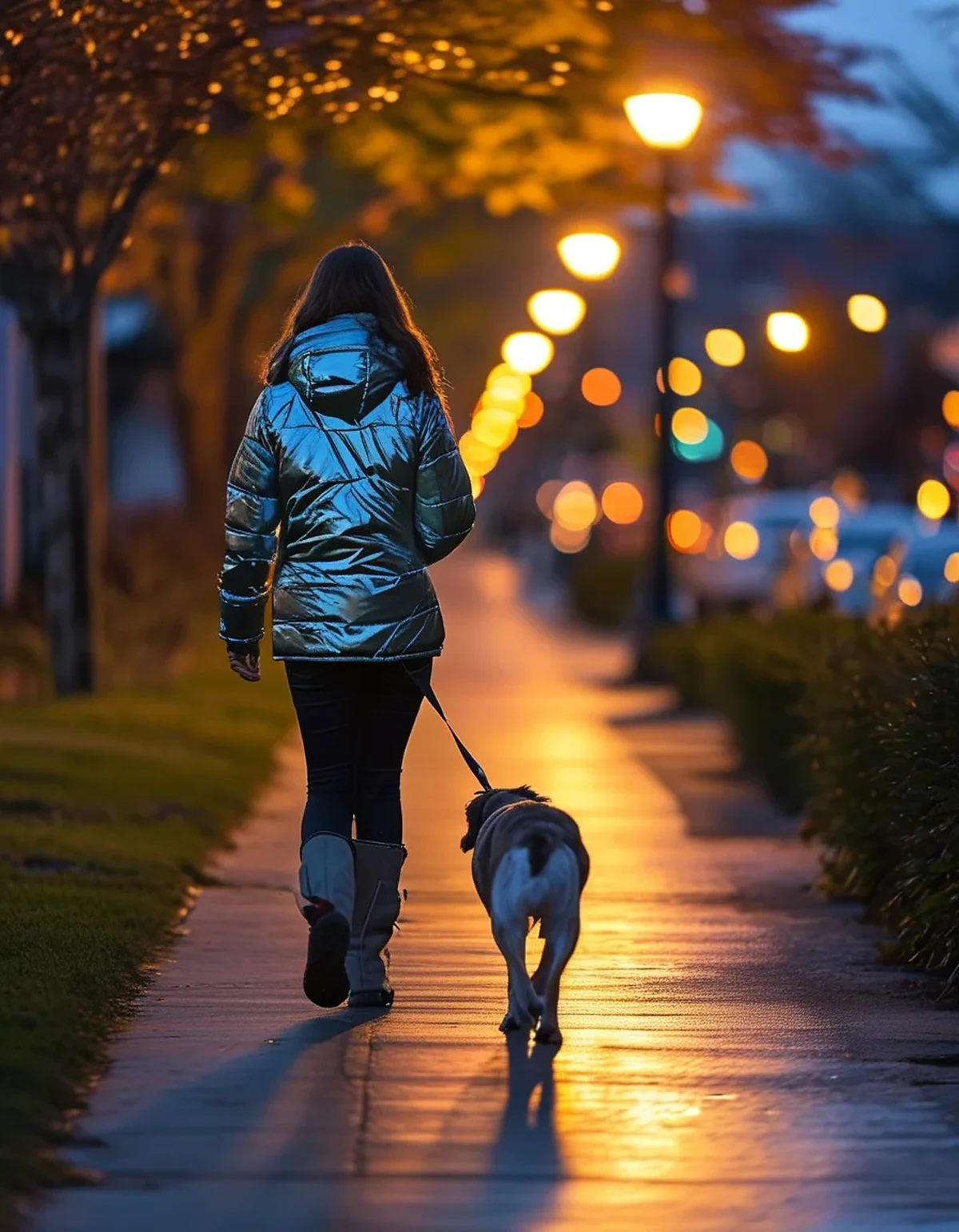
4. Choose grip over style in footwear. Wet leaves on a smooth pavement are genuinely slippery, and a dog that lunges unexpectedly applies a sideways force you were not braced for. Tread pattern matters more from October onward.
5. Switch to a windproof outer layer. For stop-start activity in cool weather, wind protection outperforms bulk.
6. Consider the route. The route that was ideal in summer may be unlit and awkward in November. A slightly less interesting but well-lit route is a reasonable seasonal trade, particularly for the last walk of the day.
7. Keep a towel by the door. Not safety, purely practical. Autumn walks end wet and muddy considerably more often than summer ones, and having a system prevents the walk from ending in a cleaning job.
Is a shorter lead better in the dark?
Many owners shorten up near roads in poor visibility, since it keeps the dog predictable and close. Extending leads in particular are harder to manage when neither you nor drivers can see where the dog is.
What nobody tells you about autumn dog walks
Your dog’s behaviour changes in the dark, not just yours. Reduced visibility, different smells, and more wildlife activity at dusk all make many dogs more reactive or more distracted in autumn evenings than they were in summer. A dog that was reliable off lead in August may not be in October.
Wildlife is more active at dusk. Foxes, deer in some areas, and cats are all more likely to be encountered, and encounters are less predictable when you cannot see them coming.
Conkers, acorns, and fallen fruit are seasonal hazards. Several are toxic to dogs and all of them are interesting to dogs. Autumn walks warrant more attention to what is being picked up, and this is one more argument for carrying a light.
Mud changes the wear on everything. Leads, harnesses, and your own clothing accumulate autumn mud in a way summer walks never produce. Washable is more useful than smart.
Grit and salt arrive later and affect paws. Once treatment of roads begins, paws are worth rinsing after walks. It is a small habit that prevents a recurring irritation.
The last walk of the day gets shorter without you deciding. Almost every owner reduces the evening walk once it is dark and cold. Being deliberate about it — a shorter walk plus indoor enrichment, rather than an unplanned reduction — keeps the dog better exercised through winter.
FAQ: Evening Dog Walk Questions, Answered
Is a hi-vis vest really necessary on a lit street?
Street lighting helps and it does not make you high-contrast. Reflective material works with headlights specifically, which is what matters for the vehicles that are actually a risk.
What colour is most visible at dusk?
Fluorescent yellow-green and orange perform best in low light, and neither works in full darkness. That is what retroreflective material is for, which is why combining the two covers the whole autumn evening.
Does my dog need a coat?
It depends on coat type, size, age, and health. Short-coated, small, very young, very old, or unwell dogs benefit most. A thick-coated breed generally does not need one and may overheat in it.
How do I keep my hands warm while holding a lead?
Gloves you can operate a phone in, and a lead that can go around your waist or across your body for parts of the walk. Hands in pockets is the instinct and it costs you the ability to react.
Are head torches better than handheld?
For dog walking, generally yes — hands free matters. A red rear light clipped to the back is a worthwhile addition on roads without pavements.
What if my usual route has no lighting?
Either light yourself properly for it, or change route for the darker months. Unlit country lanes without pavements are the highest-risk situation and warrant both reflective gear and a light.
TL;DR:
- You can see headlights long before drivers can see you — feeling visible is not being visible.
- Retroreflective material and fluorescent colour do different jobs; dusk needs both.
- A vest for you and a light for the dog are the cheapest, highest-value changes available.
- Dog walks are stop-start, so wind protection beats insulation and pockets genuinely matter.
- Autumn adds slippery leaves, seasonal hazards to eat, and more dusk wildlife activity.
The walk did not change and the light did. Twenty pounds of reflective material covers the entire difference.
This is general information, not medical advice.
Keep Reading
This article is for general informational and styling purposes only. Fit, sizing, and product availability may vary.