Why Pockets Decide a Dog Walk Outfit More Than Anything Else
Quick Answer: A dog walk asks you to carry five to seven items and access three of them one-handed within seconds — a treat during a two-second training window, a bag at the moment of need, a phone without surrendering the leash. Ordinary pockets fail on depth, bounce, and access speed, which is why the deciding feature of a dog-walk outfit is not fabric or warmth but pocket architecture: deep side pockets on the thigh, one zip for keys, and a dedicated home for each category so your hand never searches. Everything else about the outfit is negotiable.
Walk a dog twice a day and you run this logistics problem seven hundred times a year. Here is how the outfit solves it.
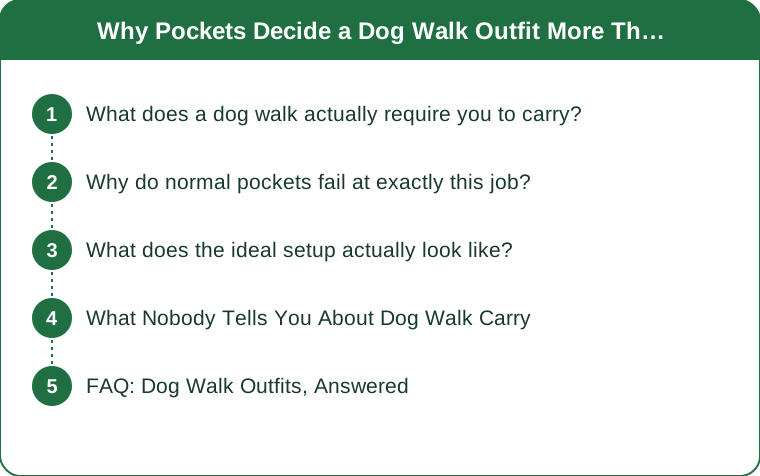
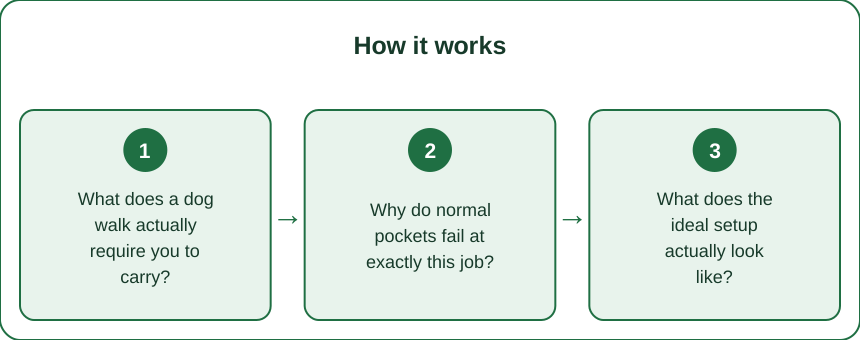
What does a dog walk actually require you to carry?
List it honestly and the problem reveals itself.
The standing inventory: phone, keys, waste bags (plural — the day you bring one is the day you need two), treats if you train at all, and in August, bug spray residue on one hand and sometimes a collapsible water option for the dog. Seasonal additions rotate in — a flashlight as evenings shorten, gloves later — but five items is the year-round floor.
The real constraint is not volume — it is that one hand is permanently employed. The leash hand is spoken for, and not passively: it manages tension, corrections, and the occasional lunge at a squirrel. Every carry, retrieve, and stow happens with the free hand, often while walking, frequently while the leash hand is under load.
And two items are on a timer. A training treat rewards a behavior only within a second or two — a treat that takes eight seconds to excavate teaches nothing except that your pocket is interesting. The waste bag has its own urgency profile, familiar to all.
This is why the outfit question is misframed as fashion. A dog walk is closer to a trade job with a uniform requirement: tools distributed for one-handed access at known locations. The horse-riding world solved this a century ago; dog walking is still mostly solving it with a hoodie pouch and hope.
Why do normal pockets fail at exactly this job?
Four failure modes, each familiar the moment it is named.
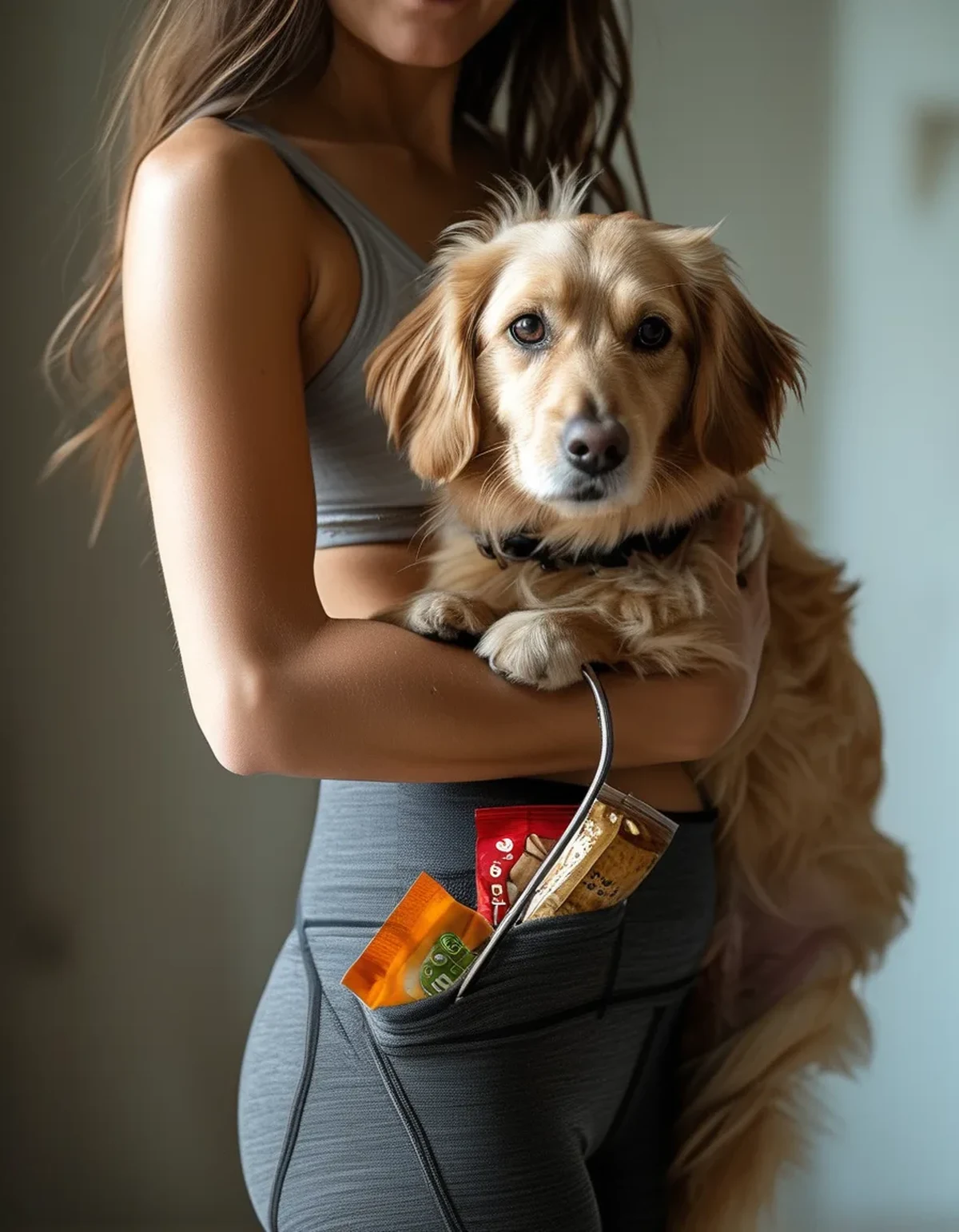
Too shallow, and movement ejects. A standard legging drop-in pocket holds a phone at rest; add the bounce of a brisk walk plus one crouch to collect after the dog, and the phone climbs. The characteristic dog-walker fear — patting the pocket every block — is the tell of a pocket that has ejected before.
Too deep without structure, and retrieval slows. A hoodie kangaroo pouch holds everything and locates nothing: treats, keys, and bags migrate into one jangling commune, and the two-second treat window closes while you dig. Capacity without segmentation is just a bag you wear.
Wrong position, and one hand cannot reach. Back pockets need a wrist angle that fights the leash posture; zip pockets behind the hip might as well be at home. The reachable zone for a loaded one-handed grab is the front and side thigh, waistband front, and chest — everything else is storage, not access.
No closure where loss is expensive. Keys in an open pocket survive the walk until the one crouch at the wrong angle. The rule writes itself: replaceable-and-fast items (treats, bags) live in open pockets; irreplaceable items (keys, cards) live behind a zip; the phone earns a deep side pocket that covers it past the halfway line.
Every frustrating walk traces to one of these four. The fixes are architectural, and they cost nothing once you shop for them on purpose.
What does the ideal setup actually look like?
Assign every category a fixed address, then buy the outfit that provides the addresses.
Bottoms do the heavy lifting. High-waisted leggings with deep side pockets on both thighs are the foundation garment of dog walking — one thigh for the phone (deep enough to swallow it past halfway), the other for treats, arriving one-handed without breaking stride. A small interior zip or waistband pocket takes keys. Yoga pants and joggers with the same architecture work identically; the non-negotiables are depth, side placement, and a secure spot for metal. High-waisted matters for a mundane reason: a loaded pocket on a low waistband drags — the anchoring of the rise is what keeps two phones-worth of cargo from pulling everything down.
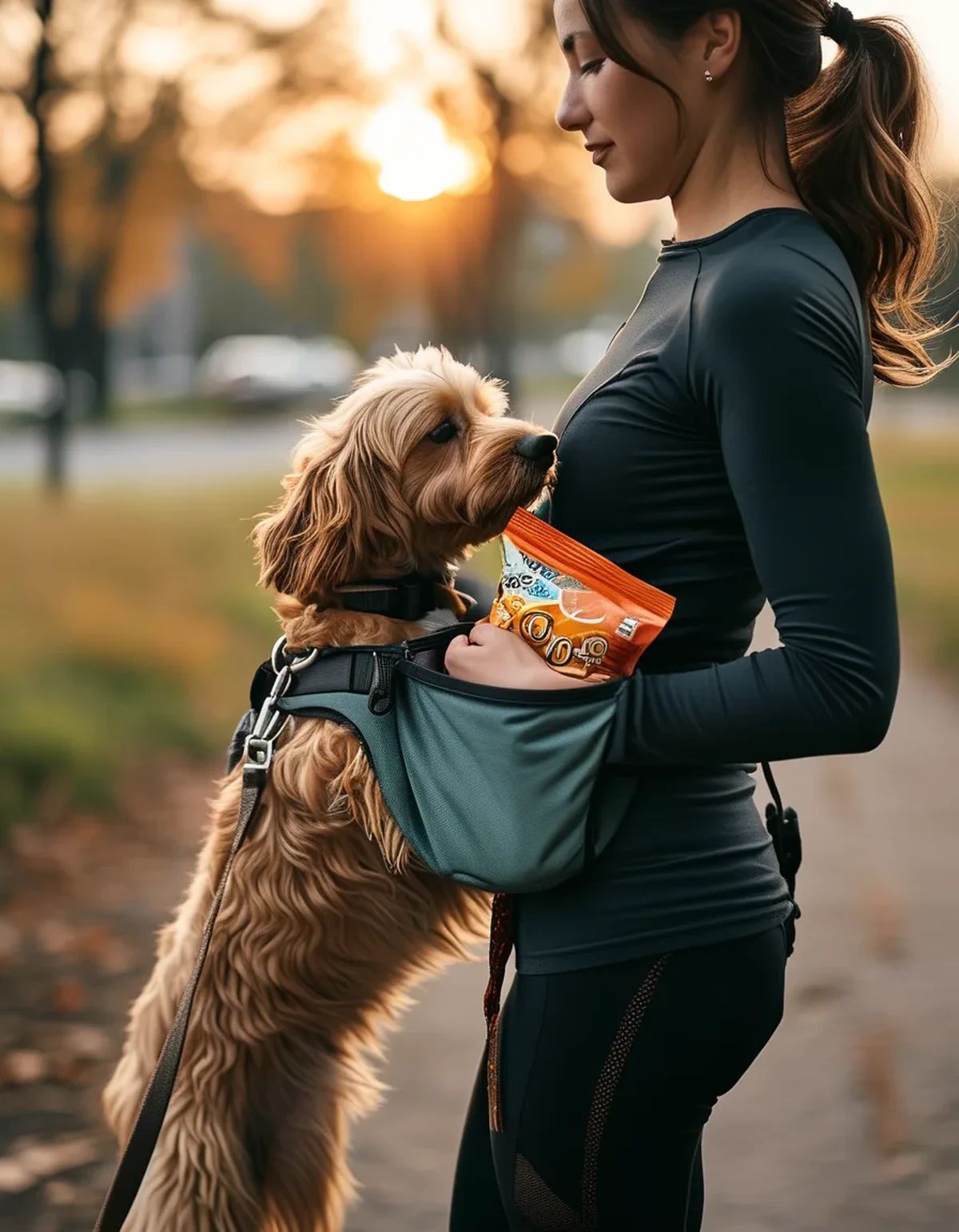
Treats get a dedicated door. Loose treats in a shared pocket become crumbs and laundry regret. A zip sandwich bag inside the treat pocket, or a small silicone pouch clipped at the waistband for serious training phases, keeps the two-second window honest and the pocket washable.
Bags live on the leash, not on you. The dispenser clipped at the leash handle is one less pocket demand, is always in the hand that needs it, and survives outfit changes — the single highest-value three-dollar object in the system.
The top stays almost cargo-free. A light layer with one chest or hand zip for seasonal extras — flashlight as the evenings pull in — and nothing else. Loading tops fails in warm months when the layer comes off mid-walk and takes its cargo with it.
The test of a working system: the entire leave-the-house sequence takes under a minute, and no item requires two hands or a glance to produce.
What Nobody Tells You About Dog Walk Carry
The used-bag leg of the walk is a design input. Between the deed and the trash can, one hand is now also occupied. Plan for it: a leash with a bag-parking clip, or the veteran’s loose-knot-on-the-leash move — because the alternative is carrying it in the treat hand, and everyone does that exactly once.
Treat pockets need laundering discipline. Crumb dust and oils accumulate in pocket seams and survive casual washing — the reason a dog can obsess over one particular legging. Bag-line the pocket, and turn pockets out every wash.
Rotate the leash hand deliberately. Habitual one-side leashing builds a lopsided pattern — one shoulder rides higher, one pocket wears out, one side of every outfit fades from sun on the same street orientation. Switching sides weekly is posture care and wardrobe care in one.
Dusk arrives earlier every week now. The August-to-October slide moves the evening walk into headlight territory faster than habit adjusts. A reflective detail on the outfit or leash, and the flashlight taking up autumn residence in the zip pocket, is the cheapest safety upgrade of the season.
Phone-out is the leading cause of tangles. The walk-scrolling posture — eyes down, leash slack drifting — is when the squirrel launch happens and the lead wraps a leg. A pocket the phone exits easily is also one it returns to easily; the deep side pocket is quietly a training aid for the human.
FAQ: Dog Walk Outfits, Answered
Are leggings with pockets really better than a small crossbody bag?
Different jobs. Pockets win on speed and bounce — nothing swings when you crouch or jog a crossing. A slim crossbody earns its place on long adventure walks where water and extras come along. The failure choice is the handbag: one shoulder, two-hand access, and it meets the ground at the worst moments.
What about running with the dog?
Same architecture, stricter standards: zip or envelope-top pockets only, phone in a side pocket that compresses it against the thigh, treats in the waistband. Canicross people add a belt — the logical endpoint where the outfit itself becomes the gear.
How do I keep treat smell from making every walk a mugging?
Seal layer first (the bag-in-pocket), washed pockets second, and treat delivery from a consistent single pocket third — a dog that knows treats come only from the left thigh, only for behaviors, stops auditing the rest of you. The nose is never defeated, only negotiated with.
Winter is coming eventually — does the system survive coats?
The addresses just move up a layer: coat side pockets take over phone and treats, keys stay in the legging zip underneath, bags stay on the leash. The principle is portable; re-run the under-a-minute door test each season and the system re-tunes itself.
TL;DR:
- A dog walk is one-handed logistics: five-plus items, two of them on a seconds timer. Pocket architecture decides the outfit.
- Foundation: high-waisted leggings with deep side pockets — phone one thigh, treats the other, keys behind a zip, bags clipped to the leash.
- Open pockets for fast replaceables, zips for irreplaceables, top layer nearly empty.
- Line the treat pocket, rotate the leash hand, add reflectivity as dusk creeps earlier.
Before tomorrow’s walk, run the door test: everything stowed, one hand, under a minute, no searching. Whatever fails the test is the next thing to fix — and it is almost always a pocket, not a dog.
See It in Motion
Seen here: High Waist Yoga Leggings with Side Pockets — shop it on bubblelime.com
Keep Reading
This article is for general informational and styling purposes only. Fit, sizing, and product availability may vary.